If you’re planning a trip to Kuching, Malaysia, two wildlife destinations will almost certainly appear at the top of every itinerary: Semenggoh Nature Reserve and Bako National Park. Both are world-class, both are accessible from the city, and both sit within the extraordinary biodiversity of Borneo’s rainforest. But they offer very different experiences — and choosing the right one (or figuring out how to do both) requires understanding what makes each place special. This guide breaks down the full comparison to help you decide which wildlife adventure belongs on your Borneo bucket list.
The At-a-Glance Comparison
| Category | Semenggoh Nature Reserve | Bako National Park |
|---|---|---|
| Star Animal | Semi-wild orangutans | Proboscis monkeys |
| Established | 1975 | 1957 |
| Distance from Kuching | ~24 km south | ~37 km northeast |
| Area | 650 hectares | 2,727 hectares |
| Entry Fee (Foreign Adult) | RM 10 | RM 20 |
| Getting There | Bus, Grab, or tour | Bus + mandatory boat transfer |
| Day Trip Possible? | Yes, easily | Yes, but overnight is better |
| Best Visit Duration | 2–4 hours | Full day or overnight |
| Wildlife Sighting Guarantee | Not guaranteed | Not guaranteed |
| Difficulty | Easy | Easy to moderate |
Semenggoh Nature Reserve: The Orangutan Sanctuary
Established in 1975, Semenggoh Nature Reserve is the most celebrated orangutan rehabilitation center in Sarawak. Approximately 30–40 semi-wild orangutans roam freely across 650 hectares of protected rainforest and are lured to feeding platforms twice a day when natural food in the jungle is scarce.
The experience at Semenggoh is intensely focused. You arrive, attend a safety briefing, walk a short jungle trail, and then wait at a feeding platform for one of nature’s most intelligent creatures to descend from the canopy entirely on its own terms. When it works — especially during the non-fruiting season from April to October — the encounter is astonishing. Animals like Ritchie, the 140 kg alpha male, can swing down just meters away from visitors. Mothers with clinging infants appear with heartwarming regularity during peak months, and on a good day you can witness up to 15 orangutans in a single session.
The limitation is predictability. During the fruiting season (November to March), when the forest overflows with wild fruit, orangutans have little incentive to visit the platform, and some visitors leave without a sighting. The entire experience lasts roughly 2–4 hours, and there is no hiking component beyond the short walk to the platform.
Semenggoh is best for: Travelers whose primary goal is a close, ethical encounter with Borneo’s most iconic great ape in a focused, guided setting.
Bako National Park: Borneo’s Wildest Day Trip
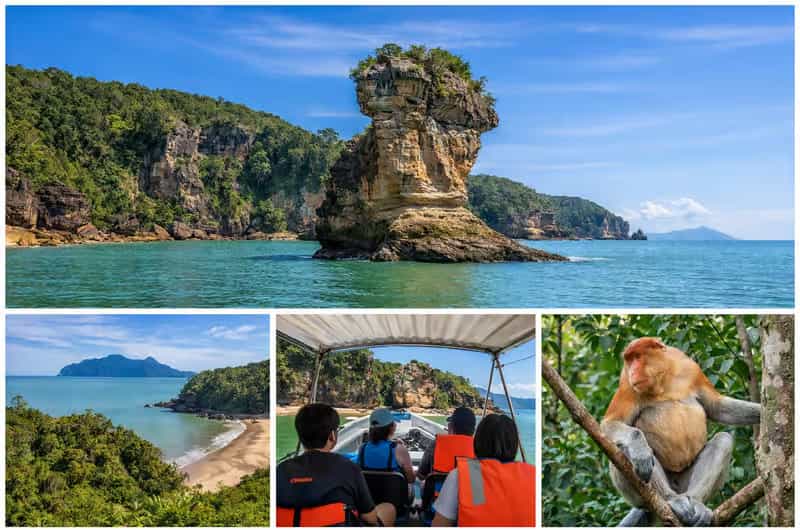
Sarawak’s oldest national park, established in 1957, Bako is a strikingly different kind of experience. Located on a peninsula jutting into the South China Sea about 37 km northeast of Kuching, the park covers 2,727 hectares packed with seven distinct ecosystems — from mangrove swamps and tropical rainforest to cliff vegetation and pristine beaches.
The star animal at Bako is the proboscis monkey — a comically charismatic primate found only in Borneo, instantly recognizable by the male’s enormous pendulous nose and pot belly. Approximately 150 proboscis monkeys live within the park, and Bako is widely considered the best place in Sarawak — possibly the world — to observe them. Beyond proboscis monkeys, Bako is also home to long-tailed macaques, silvered leaf monkeys, Bornean bearded pigs, monitor lizards, flying lemurs, and over 190 bird species.
Unlike Semenggoh, Bako rewards active exploration. The park offers 16 color-coded trails ranging from easy 20-minute strolls to full-day jungle treks across diverse terrain. The Telok Delima and Telok Paku trails are the best vantage points for proboscis monkeys in the early morning or late afternoon. The Lintang Trail takes visitors through all seven vegetation types, ending at a stunning clifftop view over the South China Sea.
Bako is best for: Travelers who want a multi-dimensional nature immersion — diverse wildlife, jungle hiking, and stunning coastal scenery all in one location.
Getting There: Ease of Access
Access is one of the biggest practical differences between the two parks.
Semenggoh is significantly easier to reach. A public bus (K6) departs from central Kuching for RM 4, a Grab ride costs RM 23–35, and organized half-day tours start at around RM 95. The journey takes 25–45 minutes along a straightforward road.
Bako requires more planning. You first take a bus from Kuching to Bako Bazaar village (about 45 minutes), then board a mandatory boat transfer across the bay to the park headquarters — a scenic but bumpy 20-minute ride that adds time and cost. Boat tickets must be pre-booked, and bad weather can delay or cancel crossings. Entry costs RM 20 for foreign adults, plus the boat transfer fee. Getting there and back takes the better part of a morning or afternoon.
Winner for convenience: Semenggoh — though Bako’s boat journey is itself part of the adventure.
Wildlife Experience: Depth vs. Focus
The core question most travelers face is whether they want a focused, high-intensity encounter with one iconic species or a diverse, exploratory wildlife experience across an entire ecosystem.
At Semenggoh, you are essentially visiting a controlled environment where the action happens in one spot, at specific times, for a limited duration. When orangutans show up, the experience is absolutely electric — raw, close, and deeply personal. But if they don’t appear, there is little else to do.
At Bako, wildlife encounters are distributed across time and terrain. Proboscis monkeys often appear near the park headquarters even before you set foot on a trail — visitors in 2024 reported seeing multiple species within the first hour of arrival. Macaques and bearded pigs are virtually guaranteed sightings. Because the park has been protected since 1957, many animals are remarkably comfortable around humans, allowing for unexpectedly close encounters.
Bako also rewards patience in ways Semenggoh cannot. An overnight stay transforms the experience: nocturnal walks reveal flying lemurs, tarsiers, pangolins, pit vipers, and slow lorises that day visitors never see. If birds are your passion, 190+ species recorded in the park make Bako one of Borneo’s premier birding destinations.
Winner for biodiversity: Bako — more species, more habitats, more active exploration.
Cost Comparison
Both parks are remarkably affordable by international standards.
- Semenggoh: RM 10 entry for foreign adults, plus optional RM 15 for the electric buggy to the center
- Bako: RM 20 entry for foreign adults, plus boat transfer fees and optional guide costs
For budget travelers, Semenggoh is the cheaper half-day option. Bako’s total costs rise quickly when you factor in two boat rides, a potential guide, and food at the canteen — though it still represents excellent value for the experience delivered.
Photography Opportunities
Both parks draw serious wildlife photographers, but for different reasons.
At Semenggoh, the challenge is proximity and behavior — orangutans can appear just 3–5 meters from visitors during peak sessions, offering intimate portrait opportunities. A standard kit lens or 70–200mm telephoto works well. Flash is prohibited, so natural light conditions matter.
At Bako, the variety is unmatched. Proboscis monkeys in the mangrove canopy, bearded pigs on the beach, hornbills in flight, and vivid pit vipers on nocturnal walks create a full spectrum of wildlife photography scenarios. Trails through different ecosystems mean dramatically varied backdrops — from dense jungle to white-sand coves.
Winner for photographers: Bako — if you want variety. Semenggoh — if you want the definitive orangutan shot.
Which Should You Choose?
The honest answer for most travelers is: do both. They are complementary experiences that together paint a complete portrait of Sarawak’s extraordinary wildlife. Semenggoh takes just half a day and can be slotted in before an afternoon of exploring Kuching; Bako deserves a full day or an overnight stay.
But if you truly must choose one:
- Choose Semenggoh if you are primarily in Borneo to see orangutans, have limited time, want an easy half-day excursion, and are visiting between April and October when sighting odds are highest
- Choose Bako if you love active hiking, want to see multiple endemic species, are comfortable with a more adventurous logistics process, or are willing to stay overnight for the full experience
The Verdict
There is no objectively “better” park — only the one that better matches your travel style and goals. Semenggoh delivers one of the most emotionally powerful wildlife moments available anywhere on earth when the orangutans appear. Bako delivers consistent, diverse, and deeply immersive encounters with Borneo’s wildlife across a far larger and more complex landscape. For a complete Kuching wildlife experience, the ideal itinerary is simple: morning at Semenggoh, overnight at Bako — and you’ll leave Sarawak with memories that last a lifetime.