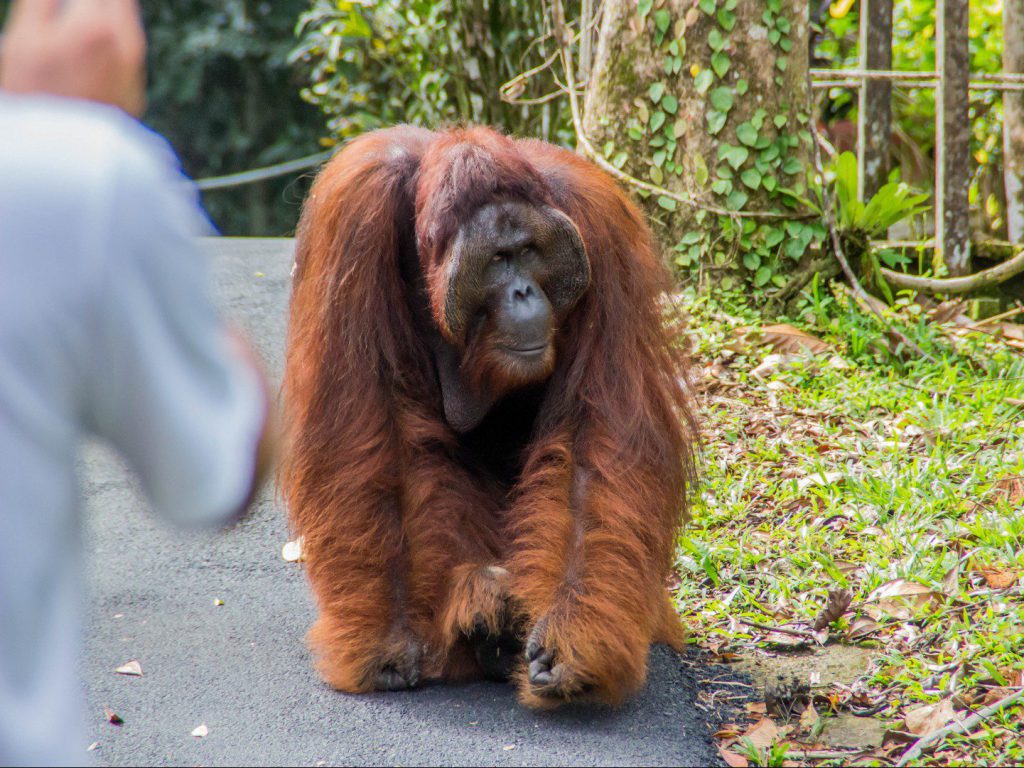
Photographing orangutans at Semenggoh presents a unique challenge—balancing the unpredictability of semi-wild animals, the technical constraints of rainforest photography, and the ethical requirement to maintain distance and avoid disturbance. Here’s how to capture compelling images while respecting both the animals and the sanctuary’s conservation mission.
Understanding Semenggoh’s Photography Rules and Constraints
Permitted:
- Photography with standard cameras, DSLRs, mirrorless cameras, and smartphones
- Telephoto and zoom lenses
- Extended observation periods for composition and timing
Prohibited:
- Flash photography (strictly discouraged to avoid disturbing the animals)
- Tripods within the viewing areas
- Drones (wildlife disturbance and sanctuary regulations)
Practical Implication:
These restrictions mean you must master hand-held photography in challenging light conditions while relying on steady hands, fast shutter speeds, and high ISO values—standard for rainforest wildlife photography.
Essential Equipment for Semenggoh Photography
Ideal Setup (DSLR/Mirrorless):
Camera Body:
- Modern DSLR or mirrorless camera with good low-light performance
- Full-frame sensors perform significantly better at high ISO than crop sensors
- Recommended: Canon EOS R5, Canon EOS 5D Mark IV, Sony a7R III/IV, Nikon Z6/Z7
Lens:
- Primary: 70-300mm or 100-400mm telephoto zoom lens
- Wide range: Essential for flexibility as orangutans move between distances
- Aperture: f/5.6 minimum; f/4 or faster is preferable for low-light performance
Example professional setup:
Sony a7R III + Sony FE 100-400mm GM (@ 400mm, f/5.6). This combination excels in rainforest conditions with excellent high-ISO performance and fast autofocus for moving subjects.
Backup/Compact Setup:
- Smaller mirrorless camera or compact DSLR
- 55-250mm or similar moderate telephoto
- Lighter weight reduces fatigue during extended waiting periods
Important Note About Gear:
Professional equipment isn’t absolutely necessary. One photographer successfully used a “Sigma 18mm to 300mm lens” with an older DSLR, achieving strong results. A quality lens matters more than having the newest camera body.
Smartphone Photography:
Modern smartphones (iPhone 12 Pro and later, recent Samsung flagships) offer surprisingly capable telephoto capabilities. While not matching dedicated cameras, they produce acceptable images for social media sharing, particularly with newer computational photography features.
Camera Settings for Rainforest Conditions
Rainforest photography demands non-traditional settings due to severely limited light penetrating the dense canopy.
ISO Settings:
- Starting point: ISO 1600-2400
- Common range: ISO 2000-4000 produces acceptable results with modern cameras and noise reduction
- High-end cameras: Can operate acceptably up to ISO 6400-12,800 with post-processing noise reduction
- Trade-off: Higher ISO means increased noise but faster shutter speeds preventing motion blur from moving animals
Shutter Speed:
- Minimum: 1/250 second for stationary orangutans
- Recommended: 1/500-1/1000 second for active animals swinging, climbing, or feeding
- Orangutans move surprisingly quickly in trees—fast shutter speeds are essential to freeze action
Aperture:
- Ideal: f/4-f/5.6 (widest available on your telephoto lens)
- Wider apertures allow more light, enabling faster shutter speeds
- f/8 aperture provides acceptable depth of field for environmental context shots showing the orangutan and surrounding habitat
Practical ISO/Shutter/Aperture Combination:
- Example 1: ISO 2500, 1/500 second, f/5.6 (professional camera setup)
- Example 2: ISO 3200, 1/400 second, f/4 (compact camera setup)
- Example 3: ISO 1600, 1/320 second, f/5.6 (if shooting at midday when more light reaches the canopy)
White Balance:
- Use “Cloudy” or “Overcast” preset rather than Auto
- Rainforest produces heavy green color cast; Cloudy setting compensates
- Shoot in RAW format to maintain white balance flexibility during post-processing
Focus Mode:
- Continuous autofocus (AF-C on Nikon, AI Servo on Canon, AF-C on Sony) essential for moving subjects
- Back-button focus (assigning focus to a rear button) separates focusing from exposure, providing better control
- Set autofocus to track faces/eyes when available on newer cameras
Metering Mode:
- Spot metering on the orangutan’s face ensures proper exposure of the subject
- Evaluative/Matrix metering often underexposes in rainforest conditions due to heavy vegetation
Composition Techniques for Compelling Orangutan Images
Environmental Context (Wide Shots):
Capture orangutans with their rainforest habitat in frame, emphasizing their dependence on towering trees and canopy ecosystem. This communicates conservation importance to viewers.
- Goal: Make the orangutan appear small against massive trees to show habitat scale
- Framing: Position the orangutan in the middle distance with forest canopy occupying foreground and background
- Aperture: f/8 to maintain depth of field—both orangutan and surrounding habitat in focus
Intimate Close-ups (Portrait Style):
Frame the orangutan’s face/upper body, filling the frame with detail—expressive eyes, facial features, and personality.
- Goal: Connect viewers emotionally with the animal’s intelligence and humanity
- Framing: Use the telephoto lens at full zoom (300mm+) to create strong compression
- Background: Blurred green rainforest creates natural bokeh softening distractions
- Eye contact: Position the orangutan’s eye in the frame’s upper third (rule of thirds) to create dynamic composition
Behavioral Action Shots:
Capture orangutans feeding, climbing, interacting with babies, or moving through the canopy.
- Goal: Tell a story—show natural behavior and ecological function
- Challenge: Maintaining fast shutter speed while tracking movement
- Technique: Use continuous shooting mode, burst mode, capturing 10-20 frames per second and selecting the sharpest frame
Mother and Baby Moments:
These are arguably the most emotionally compelling images—mothers with infants clinging to their fur.
- Goal: Showcase maternal behavior and emotional depth
- Timing: Early in feeding sessions when mothers are most likely to arrive with young
- Composition: Include both the mother’s protective posture and the baby’s vulnerability
Environmental Storytelling:
Combine the orangutan with feeding platform structure, other visitors, and rainforest setting—contextualizing the rehabilitation program.
- Goal: Document not just the animal but the human-orangutan encounter and conservation work
- Framing: Use the feeding platform or entrance structures to frame the orangutan
Timing: The Single Most Important Variable
Morning Session (9:00-10:00 AM):
Morning light generally penetrates the canopy more effectively than afternoon, though rainforest light remains challenging.
- Advantages: Better light than afternoon, fewer clouds, orangutans often more active
- Best window: 9:00-9:30 AM (immediate after rangers place food)
- Disadvantage: Higher tourist volume creates background clutter and potentially spook orangutans
Afternoon Session (3:00-4:00 PM):
Afternoon light is lower, often dimmer, but frequently less crowded.
- Advantages: Fewer tourists, potentially better animal behavior in quieter environment
- Challenges: Lower light requires higher ISO and potentially slower shutter speeds
- Best window: 3:00-3:30 PM (first half of session before light degrades further)
Weather Impact on Light:
- Sunny days: Most light penetrates canopy; ISO can be reduced to 800-1200
- Overcast mornings: Light remains diffuse; ISO 1600-2400 typical
- Rainy conditions: Severe light loss (ISO 3200+); orangutans often skip feeding sessions entirely
Pro Strategy:
Arrive early enough to photograph both morning and afternoon sessions (staying 6+ hours). Morning provides better light; afternoon may offer different animals and less-crowded composition opportunities.
Handling Challenging Rainforest Conditions
Low Light Management:
Rainforest presents the most significant photography challenge. At ground level, insufficient light exists for most plants to grow—creating extreme darkness for photography.
Solutions:
- Accept high ISO: Modern cameras handle ISO 2000-4000 well with noise reduction software
- Widen your aperture: Use the largest aperture available on your telephoto lens
- Increase shutter speed budget: Accept slightly slower shutter speeds (1/250 rather than 1/1000) if necessary
- Prioritize metering: Use spot metering on the orangutan’s face to ensure proper exposure
Equipment Protection from Humidity:
Tropical humidity destroys camera gear—lens fog, corrosion, and fungal growth are genuine threats.
Prevention:
- Store gear in airtight cases with silica gel packets overnight
- Change lenses only indoors in humidity-controlled environments
- Clean optics frequently with lens cloths and clean hands
- Keep gear sealed in waterproof bags during rain, removing before heavy downpours begin
Battery Management:
Tropical heat and humidity severely reduce battery life. A fully charged battery may lose 20-30% capacity in hot, humid conditions.
Solutions:
- Bring two fully charged batteries; use one until completely depleted
- Store spare battery in cool, dry location (inside the airtight case with silica gel)
- Turn off the camera between feeding appearances to conserve power
- Charge overnight using hotel AC power
Monitor Fogging:
Lens fogging from humidity transitions (moving from cool air-conditioned buildings to hot, humid forest) prevents photography for 10-15 minutes.
Prevention:
- Allow camera and lenses to acclimate to ambient temperature before opening cases
- Keep camera in sealed bag for 15-20 minutes after exiting air-conditioned transportation
- Pre-emptively place desiccant packets in camera bag
Smartphone Photography at Semenggoh
Modern smartphones offer viable orangutan photography, particularly for casual travelers and social media sharing.
Advantages:
- No separate equipment to carry and protect
- Instant sharing and backup to cloud services
- Computational photography (portrait mode, scene detection) improves results automatically
Recommended Phones:
- iPhone 12 Pro/Pro Max or newer (10x optical zoom, good low-light performance)
- Samsung Galaxy S21 Ultra or newer (10x optical zoom, Night Mode)
- Google Pixel 6 Pro (excellent computational photography in low light)
Camera Settings:
- Use telephoto lens (3x, 5x, or 10x optical zoom—not digital zoom)
- Switch to “Portrait Mode” for automatic background blur
- Use Night Mode if available in low-light conditions
- Tap the orangutan to set focus and exposure on the subject
Limitations:
- Cannot achieve the shallow depth-of-field of telephoto lenses
- Noise at high ISO more pronounced than dedicated cameras
- Cannot manually adjust shutter speed or aperture on most phones
Best Results: Shoot during morning session for better light; stay within 15-20 meters of the feeding platform for optimal telephoto range.
Ethical Photography Practices at Semenggoh
Maintain Distance:
Respecting the sanctuary’s rules isn’t just ethically correct—it produces better photography. Orangutans habituated to close human approach lose natural behavior and fear responses essential for wild survival.
Minimize Disturbance:
- Stay quiet during feeding to avoid startling animals
- Do not use flash or loud camera sounds
- Avoid sudden movements when orangutans are visible
Respect Ranger Instructions:
Rangers manage the experience for animal welfare. If they ask you to step back or move, comply immediately. Their priority is the orangutans’ well-being, not your photograph.
Meaningful Photography:
Rather than simply collecting images, create photographs that tell a conservation story. Include habitat context, show behavioral significance, and capture images that communicate why these animals matter. Photography with purpose—images that inspire conservation action—justifies the wildlife interaction.
Post-Processing Workflow
In-Camera:
Shoot RAW format, not JPEG. RAW files retain information lost in compressed JPEG, critical for rainforest photography where exposure and white balance are challenging.
Basic Adjustments:
- White balance correction: Compensate for green color cast from rainforest foliage
- Exposure: Slight brightening often necessary due to low-light metering challenges
- Vibrance: Moderate increase enhances color without looking artificial
- Sharpening: Necessary for high-ISO images; apply judiciously to avoid artifacts
- Noise reduction: Use noise reduction software designed for wildlife photography
Recommended Software:
- Adobe Lightroom (comprehensive RAW editing)
- Capture One (specialized wildlife performance)
- DxO PureRaw or Topaz Denoise AI (specialized high-ISO noise reduction)
Ethical Editing:
- Avoid removing or adding elements (maintaining documentary integrity)
- Allow natural-looking color correction, but don’t fabricate non-existent elements
- Cropping and composition adjustments are acceptable; species substitution or landscape alteration are not
Common Photography Mistakes to Avoid
1. Ignoring Focus on the Eyes:
The difference between a compelling portrait and a mediocre photo often lies in eye sharpness. Ensure the nearest eye is in focus.
2. Shooting Only at Maximum Zoom:
While telephoto compression is valuable, include some shots at medium zoom showing environmental context.
3. Excessive Digital Zoom:
Only use optical zoom on your lens or phone. Digital zoom is interpolation—creating fake pixels that reduce image quality.
4. Not Banking Enough Light:
In rainforest conditions, your light meter often lies. Shoot at higher ISO and faster shutter speed than your meter suggests; you can always darken during post-processing if overexposed.
5. Forgetting About Background:
A sharp orangutan with a cluttered background fails. Position yourself or wait for the orangutan to move such that the background is clean green foliage.
6. Stressing About Perfection:
The most memorable photos often occur when you’ve stopped worrying about settings and simply captured the moment. Once you understand exposure basics, focus on timing and composition.
Final Perspective: Why Imperfect Photos Still Matter
Photographs from Semenggoh, even technically imperfect ones, document critically endangered animals in a genuine conservation setting. High-ISO noise, motion blur from missed shutter speed, or suboptimal focus are trivial compared to the significance of capturing proof that rehabilitation works—that wild orangutans thrive, reproduce, and live freely.
The most valuable Semenggoh photograph isn’t necessarily technically perfect. It’s the image that moves you emotionally, that communicates why these animals deserve protection, and that reminds viewers of our shared humanity with these remarkable “people of the forest.”
Pursue that photograph. Master your camera’s settings. Respect the animals and the sanctuary. And capture images that don’t just document an encounter but inspire conservation action—that’s the real power of orangutan photography.