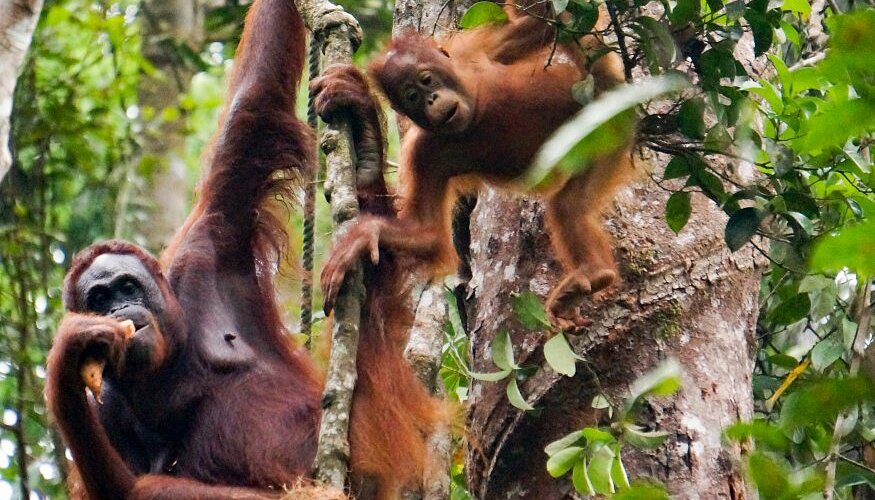
While orangutans dominate Semenggoh’s reputation, the 653-hectare reserve functions as a complete rainforest ecosystem. The sanctuary harbors one of the world’s most biodiverse habitats, home to remarkable mammals, hundreds of bird species, reptiles, amphibians, insects, and a botanical treasure trove of over 541 tree species. Here’s a comprehensive guide to the non-orangutan wildlife that enriches the Semenggoh experience.
Primates: Beyond the Orangutans
Gibbons (Hylobatidae family)
The haunting, melodic gibbon call—often described as an eerie, echoing song—is perhaps the most distinctive sound of Semenggoh’s forest. However, seeing the animals themselves remains challenging.
- Characteristics: Small, agile primates weighing 7-12 kg with notably long arms (relative to body size, they have the longest arm-to-body ratio of any ape)
- Behavior: Largely arboreal, spending entire lives in the canopy; incredibly acrobatic, capable of spectacular leaping and swinging
- Diet: Primarily frugivores (fruit-eaters), supplemented with leaves and insects
- Viewing probability: Low; gibbons are shy, fast-moving, and territorial
- Best observation: Early morning when gibbons are most vocally active; listen for their distinctive calls to locate them visually
Macaques (Cercopithecidae family)
More commonly observed than gibbons, several macaque species inhabit Borneo’s forests, though specific species at Semenggoh require confirmation.
- Characteristics: Robust primates with tails, organized into hierarchical social groups
- Behavior: Ground and tree foragers; move in organized troops; relatively bold around human activity compared to other primates
- Diet: Omnivorous—fruits, leaves, insects, occasionally small animals
- Viewing probability: Moderate to high; occasionally seen during daytime forest walks
- Distinguishing feature: Social structure clearly visible through group interactions
Slow Loris (Nycticebus spp.)
One of Borneo’s most remarkable but rarely encountered nocturnal primates.
- Characteristics: Small, round-bodied, intensely cute primates with enormous forward-facing eyes adapted for nocturnal vision
- Unique trait: One of the very few venomous mammals globally—slow lorises produce a toxin in their arm glands and combine it with saliva to create a genuinely toxic bite used against predators
- Behavior: Solitary or paired; move slowly and deliberately (hence the name) with minimal noise
- Diet: Primarily gums, nectar, and insects
- Viewing probability: Extremely low; nocturnal and cryptic, typically found only on night walks with experienced guides
- Conservation note: A new species, the Kayan slow loris, was discovered in Borneo in 2012
Small Mammals: Squirrels and More
Giant Squirrels (Ratufa genus)
Among Borneo’s most visually impressive small mammals, though spotting them remains challenging.
- Characteristics: Large tree squirrels with impressive bushy tails and prominent ears
- Size: Can reach 40+ cm body length with tails nearly as long
- Behavior: Arboreal; surprisingly elusive despite their size; typically remain high in the canopy
- Diet: Frugivorous, specializing in seeds and nuts
- Viewing probability: Low; require patience and luck
- Distinctive appearance: Reddish-orange coloration with distinctive facial markings
Pygmy Squirrels (Petaurillus genus)
Among the world’s smallest squirrel species, representing the opposite extreme from giant squirrels.
- Characteristics: Tiny squirrels weighing only 17-31 grams (roughly the mass of a house sparrow)
- Size: Body length of only 80-95 mm with tails nearly equal in length
- Behavior: Arboreal; extremely difficult to detect despite their abundance
- Viewing probability: Extremely low without specialized night searches
- Conservation note: Species like Petaurillus emiliae (Emilia’s pygmy flying squirrel) represent some of the world’s rarest small mammals
Flying Squirrels (Pteromyinae subfamily)
Borneo hosts 14 species of flying squirrels—remarkable gliding mammals with patagium (skin membranes stretching from wrist to ankle).
- Characteristics: When gliding, their skin membranes inflate like parachutes, enabling flights exceeding 100 meters between trees
- Red Giant Flying Squirrel: Largest species, reaching approximately 90 cm (3 feet) including tail; russet red coloration with needle-sharp claws
- Behavior: Nocturnal; spend daylight in tree cavities, emerging in late afternoon for spectacular gliding displays
- Steering mechanism: Long, bushy tail acts as a rudder, enabling mid-flight directional control and precise landing maneuvers
- Viewing probability: Low during the day; night walks offer better chances
- Conservation note: Elusive nocturnal behavior means population estimates remain uncertain
Carnivores: Borneo’s Elusive Predators
Clouded Leopard (Neofelis diardi)
One of Borneo’s most exotic carnivores, though sightings at Semenggoh are exceptionally rare.
- Characteristics: Medium-sized cat (weighing 1.5-2.5 kg) with distinctive clouded markings on its coat
- Teeth: Possess the longest canine teeth relative to body size of any living cat, designed to pierce through thick skulls
- Arboreal tendency: Spend significant time in trees—unusual for cats
- Hunting strategy: Ambush predators, remarkably cryptic
- Viewing probability: Nearly zero; extremely elusive and rare
- Conservation status: Endangered throughout Borneo due to habitat loss
Civet Cats (Viverridae family)
Small carnivores representing an important ecological link in rainforest food webs.
- Characteristics: Varied species with distinctive markings; typically 1.5-3 kg
- Nocturnal tendency: Most active at night, making daytime encounters rare
- Habitat role: Important fruit dispersers and insect controllers
- Viewing probability: Low; nocturnal and cryptic
Sun Bear (Helarctos malayanus)
Threatened throughout Borneo, these small bears remain extremely rare at Semenggoh.
- Characteristics: Smallest bear species; characterized by distinctive white/cream-colored V-shaped chest marking
- Behavior: Solitary, largely nocturnal; spend significant time on the ground searching for invertebrates
- Viewing probability: Extremely low; endangered and sparse
Bird Species: Semenggoh’s Avian Diversity
Semenggoh harbors an extraordinary diversity of bird species, though exact numbers for the reserve specifically remain undocumented. Based on Sarawak’s broader bird population (approximately 795 species recorded), Semenggoh likely hosts 100-200 species.
Hornbills (Bucerotidae family)
Iconic rainforest birds, with multiple species recorded in Sarawak.
- Rhinoceros Hornbill: Largest Bornean hornbill; characterized by a massive, curved bill with a prominent casque (bony helmet)
- Helmeted Hornbill: Another large species; possesses a massive black-and-ivory casque used in territorial headbutting displays
- Distinctive feature: Long tail feathers used as rudders during flight; low, heavy wing-beats create distinctive sounds
- Behavior: Often seen in pairs or small flocks; loud, distinctive calls carry through the forest
- Viewing probability: Moderate; heard regularly, seen occasionally
- Ecological role: Important seed dispersers; their large fruits feed numerous forest species
Kingfishers (Alcedinidae family)
Multiple kingfisher species exploit Semenggoh’s forest streams and canopy.
- Blue-eared Kingfisher: Brilliant turquoise plumage; specializes in small forest streams
- Stork-billed Kingfisher: Larger species with impressive orange bill; hunts fish and aquatic prey
- Viewing probability: Moderate to high; particularly near water features
- Identifying feature: Distinctive diving behavior—plunge-dives into water at high speed
Sunbirds (Nectariniidae family)
Small, brilliantly colored passerines feeding on nectar from flowering plants.
- Characteristics: Often iridescent plumage in brilliant reds, golds, and greens; long, curved bills adapted for nectar feeding
- Behavior: High-energy birds; rapid movements among flowering vegetation
- Viewing probability: Moderate; particularly abundant during flowering season
- Best observation: Watch flowering trees during early morning hours
Bulbuls, Barbets, Broadbills, and Trogons
Sarawak records diverse populations of these smaller songbirds:
- Ten woodpecker species recorded in broader Sarawak
- Five broadbill species with distinctive plumage and behavior
- Six barbet species including the Red-throated Barbet and Blue-eared Barbet
- Two trogon species (Resplendent Trogon, Red-headed Trogon)
- Sixteen bulbul species including the globally threatened Straw-headed Bulbul
Raptors (Eagles, Hawks, Falcons)
Though rarely observed, raptors hunt throughout Semenggoh’s canopy.
- Wallace’s Hawk Eagle: Specialized forest canopy predator
- Fish Eagles: Occasionally hunt along waterways
- Crested Goshawk: Forest specialist
Viewing Strategy:
Early morning (6:00-8:00 AM) offers the best birdwatching opportunities when birds are most vocally active and feeding. Bring binoculars and a Borneo-specific bird identification guide. The forest canopy’s height and density make many birds difficult to observe despite their abundance.
Reptiles and Amphibians
Monitor Lizards (Varanidae family)
Large, powerful predatory lizards inhabiting forest floors and lower canopy.
- Characteristics: Grow to 1-2 meters; impressive predators with powerful claws and teeth
- Behavior: Carnivorous; hunt small mammals, birds, and invertebrates
- Viewing probability: Low; primarily nocturnal or active during cooler hours
Snakes
Borneo hosts numerous snake species, including both venomous and non-venomous species.
- Characteristics: Enormous diversity including pit vipers, cobras, rat snakes, and many cryptic species
- Viewing probability: Low; snakes are generally cryptic and avoid human contact
- Safety note: While snakes are present, human-snake encounters at Semenggoh are exceptionally rare
Frogs and Amphibians
Borneo’s tropical rainforests contain extraordinary amphibian diversity, though most species remain undescribed scientifically.
- Diversity: Estimated hundreds of frog species in Borneo; many restricted to specific habitat types
- Nocturnal activity: Most vocal and active at night, particularly during and after rain
- Sound: The forest’s evening soundscape—characterized by countless frog calls—represents an auditory indicator of rainforest health
- Viewing probability: Easy at night; listen for distinct calls to locate frogs
Invertebrates: The Often-Overlooked Majority
The vast majority of Semenggoh’s fauna consists of invertebrates—insects, spiders, and other arthropods representing thousands of species.
Insects: The Biodiversity Foundation
- Ants: Borneo may harbor over 1,000 ant species, representing approximately 30% of global ant genera
- Beetles (Coleoptera): Estimated thousands of species; represent the single most diverse animal group globally
- Hymenoptera: Sawflies, wasps, and bees; critical pollinators and parasitoids
- Termites: Extraordinarily abundant; fundamental to nutrient cycling and soil formation
Butterflies
Borneo hosts hundreds of butterfly species, many vibrantly colored and endemic.
- Characteristics: Diverse color patterns from camouflaged brown species to brilliant iridescent blues and oranges
- Viewing probability: Moderate to high; attracted to flowering plants, particularly during sunny weather
- Peak activity: Midday through afternoon
Other Arthropods:
- Walking Stick Insects (Phasmatodea): Masters of camouflage; appear identical to dead branches or leaves
- Spiders: Extraordinary diversity; found from underground burrows to canopy webs; include both harmless and venomous species
- Lanternflies: Colorful, peculiar insects with distinctive spotted patterns
- Praying Mantises: Ambush predators with remarkable camouflage
Ecological Significance:
These invertebrates, while often overlooked by casual visitors, represent 99% of Semenggoh’s animal biomass and drive fundamental ecosystem processes—pollination, seed dispersal, nutrient cycling, and predation.
Flora: The Living Framework of Semenggoh
Forest Structure and Canopy Composition
Semenggoh represents a primary lowland mixed dipterocarp forest—a specific forest type found only in Southeast Asian lowlands.
- Canopy structure: Multiple layers from emergent trees (40+ meters height) through midstory to understory; continuous canopy coverage minimizes ground-level light
- Total trees recorded: 2,837 individual trees across 4 hectares of study plot; suggesting approximately 700 trees per hectare
- Basal area: 43.04 m² per hectare (total cross-sectional area of tree trunks at breast height), indicating extremely dense forest
Dipterocarp Trees: The Forest Dominants
The Dipterocarpaceae family represents the most significant tree family in Semenggoh, contributing 25%+ of all trees and the highest percentage of forest biomass.
- Shorea (sal) genus: Most abundant dipterocarp; 515 individual trees recorded (71.53% of total dipterocarps)
- Hopea genus: Secondary abundant; 86 individuals (11.91% of dipterocarps)
- Characteristics: These massive trees reach 40+ meters height; provide structural support for the entire forest ecosystem
- Ecological role: Dominate nutrient cycling; provide food sources (seeds, flowers) for countless animals
- Conservation significance: 62% of Bornean endemic dipterocarps are threatened with extinction due to logging and forest conversion
Tree Diversity Beyond Dipterocarps
The non-dipterocarp component contributes to extraordinary species richness:
- 541 total tree species recorded in the 4-hectare study plot
- Pouteria malaccensis (Sapotaceae family): Most abundant non-dipterocarp species; 31 trees per hectare
- Eugenia and Artocarpus: Other significant non-dipterocarp families
- Euphorbiaceae and Malvaceae: Most diverse families at genus level (10 genera each)
Botanical Research Centre (BRC)
The Botanical Research Centre, occupying 22 hectares within Semenggoh, maintains specialized gardens and research collections.
- Seven specialized gardens: Medicinal plant collection, orchid garden (planned expansion in 2022), native tree nursery, and others
- Mission: Ex-situ conservation of Sarawak’s genetic plant resources; research and public education in tropical botany
- Orchid initiative: Sarawak government allocated RM 5 million to develop a model orchid garden at Semenggoh for research and commercial potential
Understory and Epiphytic Flora
Beyond large trees, Semenggoh harbors rich understory vegetation:
- Lianas and climbing vines: Significant biomass contributors; provide aerial highways for orangutans and other canopy-dwelling animals
- Epiphytes: Orchids, bromeliads, and other plants growing on tree trunks without parasitizing the tree; create microhabitats for insects and other arthropods
- Medicinal plants: Indigenous species used traditionally by Sarawak’s ethnic groups
Forest Floor and Decomposition Layer
- Leaf litter: Thick accumulation of dead leaves, fallen branches, and woody debris; supports fungi, insects, and nutrient cycling organisms
- Fungi: Essential decomposers; many form symbiotic relationships with tree roots (mycorrhizae), enhancing nutrient uptake
- Soil fauna: Earthworms, termites, and arthropods; regulate decomposition and soil structure
Seasonal Variations in Wildlife Activity
Fruiting Season (November-March)
During this period, abundant wild fruit reduces animals’ dependence on supplementary feeding:
- Orangutans spend more time foraging independently; visitor sightings drop
- Frugivorous birds (hornbills, bulbuls, sunbirds) congregate around fruiting trees
- Some terrestrial mammals become more active searching for fallen fruits
Dry Season (April-October)
With reduced wild fruit availability:
- Orangutans more regularly visit feeding platforms
- Bird activity increases as wild food becomes scarcer
- Water sources become concentrated, attracting animals to specific locations
Best Practices for Wildlife Observation
Timing:
- Early morning (6:00-8:00 AM): Most animals active; birds vocally display; cooler temperatures increase activity
- Late afternoon (3:00-4:00 PM): Secondary peak activity period
Approach and Behavior:
- Remain quiet to avoid startling animals
- Move slowly and deliberately
- Stop frequently to scan the canopy and listen for vocalizations
- Use binoculars to observe distant animals
Realistic Expectations:
Many Semenggoh visitors encounter primary large animals (orangutans, macaques) but miss the countless bird and invertebrate species. Success depends largely on luck, patience, and spending extended time (4+ hours) in the forest.
Conservation Significance
Semenggoh’s fauna and flora represent irreplaceable biodiversity. As one of the only remaining primary lowland mixed dipterocarp forests near Kuching city, the reserve functions as a crucial genetic reservoir for Borneo’s threatened species—particularly the dipterocarps, of which 62% face extinction risk globally.
The interconnected web of orangutans, gibbons, birds, insects, and plants represents a functioning rainforest ecosystem. Observing this complex system—even focusing primarily on orangutans—provides profound insight into tropical forest ecology and conservation imperatives. Every animal observed, from massive hornbills to invisible insect pollinators, plays a critical role in maintaining the forest that has sustained Borneo’s incredible biodiversity for millennia.