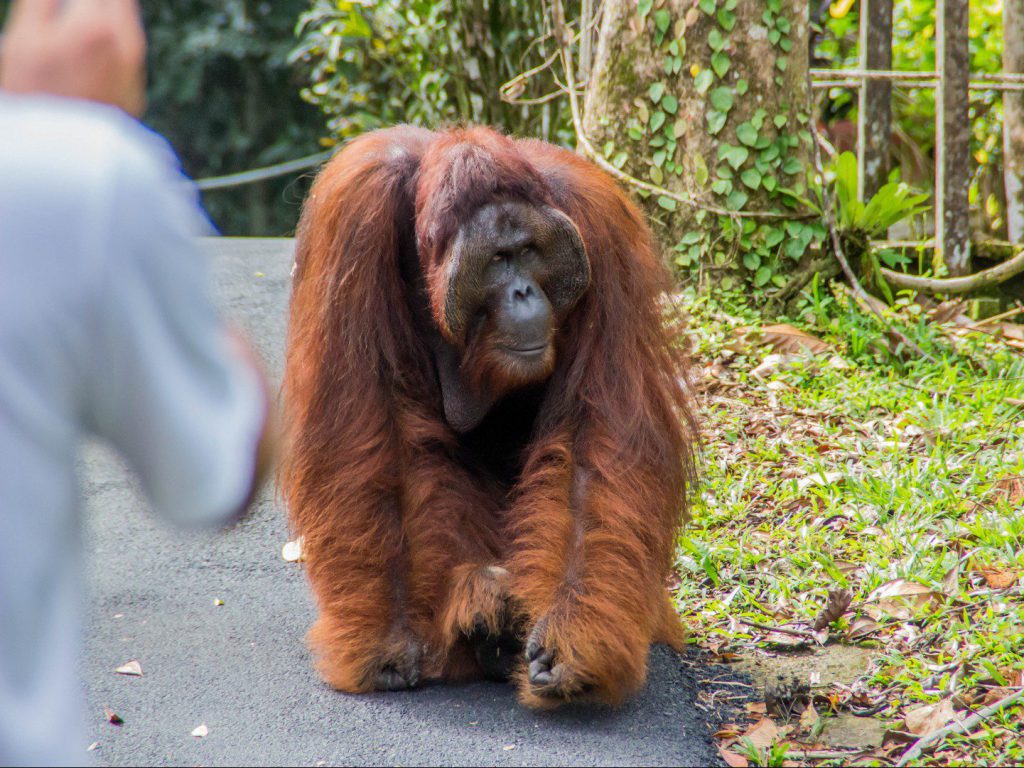
Semenggoh Wildlife Centre represents one of the world’s most successful orangutan rehabilitation programs, transforming rescued, injured, and orphaned orangutans into independent forest dwellers. Since its establishment in 1975, the center has rehabilitated dozens of orangutans and created a thriving semi-wild colony that now spans multiple generations of wild-born offspring. Understanding this program reveals why Semenggoh stands apart as a conservation leader.
The Origins and Evolution of Semenggoh’s Mission
Initial Establishment (1975):
Semenggoh was established as an active rehabilitation center responding to a critical crisis: orangutans were being seized from illegal captivity, found injured in cleared forests, or orphaned after their mothers were killed during habitat destruction. The center’s mandate was straightforward—nurse these animals back to health and prepare them to return to the wild.
Early Success (1975-1990):
During its first 15 years, Semenggoh successfully rehabilitated multiple orangutans and released them into the protected forest reserve. By 1990, a growing population of semi-wild orangutans was thriving independently in the forest, returning only for supplementary feedings. This represented a genuine conservation breakthrough—animals that had experienced captivity could successfully transition to independent forest life.
Transition to Current Model (1990s-Present):
As Semenggoh’s success compounded through wild-born offspring, the forest reserve’s carrying capacity became a limiting factor. Rather than continue active large-scale rehabilitation at an over-capacity facility, Sarawak Forestry Corporation made a strategic decision: establish a second rehabilitation center (Matang Wildlife Centre, opened 1997) for new rescue cases while maintaining Semenggoh as a sanctuary for released animals and their descendants.
Today, Semenggoh focuses on long-term observation, research, and breeding support for its semi-wild colony rather than active rehabilitation. However, Semenggoh’s historic rehabilitation achievements and ongoing management of released populations remain the foundation of Malaysia’s orangutan conservation success.
Understanding Orangutan Rehabilitation Stages
To understand what Semenggoh accomplishes, it’s essential to grasp that orangutan rehabilitation is fundamentally different from typical animal rescue. Young orangutans in the wild spend 6-8 years learning from their mothers—acquiring skills like nest building, foraging, climbing, and social interaction. Orphans rescued as infants must compress decades of natural learning into an intensive rehabilitation program.
The Rehabilitation Process (as practiced at centers like Semenggoh’s original programs and continued at Matang):
Stage 1: Rescue and Medical Quarantine (0-3 months)
When an orangutan is rescued from captivity, illegal pet trade, or injury, it enters quarantine. Rangers conduct:
- Thorough veterinary examination and disease screening
- Blood work and fecal analysis to identify parasites and pathogens
- Assessment of psychological trauma (many infants have witnessed their mother’s death)
- Isolation to prevent disease transmission to other center orangutans
This critical period allows the traumatized animal to become acclimated to the center while veterinary staff treat illnesses and injuries.
Stage 2: Medical Treatment and Socialization (3-12 months)
Once cleared medically, the orangutan begins socialization with other orphans at similar developmental stages. Professional caregivers act as surrogate mothers, providing:
- 24-hour care for infants requiring bottle feeding (critical at this stage)
- Emotional support and structured routine
- Gradual introduction to forest environment while maintaining safety
This period establishes the foundation for psychological recovery and peer bonding essential for future wild release.
Stage 3: Jungle School and Skills Training (1-5+ years)
This stage represents the core of rehabilitation—teaching wild survival skills that natural mothers would impart. The curriculum includes:
- Climbing and arboreal movement – Developing strength and confidence in trees
- Foraging techniques – Learning to identify edible plants, fruits, insects, and other foods; understanding seasonal availability
- Nest building – Constructing safe sleeping platforms in tree canopies—critical for wild survival
- Social behavior – Learning appropriate interaction with conspecifics, hierarchy recognition, and communication
- Predator awareness and avoidance – Understanding natural threats and defensive strategies
Modern jungle schools, as described by primatologist Dr. Signe Preuschoft, emphasize “orangutanizing the caregivers and avoiding humanizing the orangutans.” This means:
- Caregivers dress in camouflage and minimize speech
- Orphans spend 24 hours in forest habitat with human surrogate mothers present but non-intrusive
- Learning occurs at each individual’s pace through natural exploration and guided experience
- Caregivers teach by modeling behavior (showing how to find food, build nests) rather than commanding
Duration: This stage typically requires 3-7 years depending on the animal’s age at rescue and learning speed. An orangutan rescued at age 3 requires far less rehabilitation than one rescued as an infant.
Stage 4: Pre-Release Assessment (Final 6-12 months)
Before release, centers conduct rigorous evaluation:
- Behavioral assessment—Can the animal survive without human support?
- Health certification—Is the orangutan disease-free and physically healthy?
- Social readiness—Can it navigate social hierarchies with wild-born and previously released individuals?
- Forest competency—Can it forage, build nests, and move arboreal canopy confidently?
Only individuals meeting all criteria proceed to release.
Stage 5: Post-Release Monitoring (Ongoing)
After release, centers monitor animals for extended periods:
- Radio collar or GPS tracking for early identification of problems
- Periodic health checks and supplementary feeding during difficult seasons
- Behavioral observation to assess integration and survival success
- Intervention only when animals face life-threatening situations
This monitoring phase can last 1-3 years before animals are considered established.
Semenggoh’s Evolution from Active Rehabilitation to Semi-Wild Sanctuary
The Success That Created a Challenge:
Semenggoh’s rehabilitation success created an unexpected problem. By the 1990s, successfully released animals not only survived but reproduced. The first rehabilitated orangutans had babies. Those babies, born wild but with rehabilitated mothers, were entirely wild in behavior. By the early 2000s, multiple generations had been born—creating a sustainable, growing population.
The forest reserve simply couldn’t accommodate more orangutans. Adult males require territories of at least 1.5 square miles. With limited space, adding more released animals would trigger destructive territorial conflicts.
Strategic Transition:
Rather than housing rehabilitation animals at Semenggoh (where space was full), Sarawak Forestry established Matang Wildlife Centre as the primary rehabilitation facility. This allowed Semenggoh to shift focus to supporting its semi-wild colony:
- Research on orangutan behavior and ecology
- Monitoring the breeding population
- Providing supplementary feeding for released animals
- Managing territorial disputes and health issues
- Observing multi-generational family dynamics
Current Population Composition:
Today’s Semenggoh colony (~30-40 individuals) includes:
- Original rehabilitated animals – Released in the 1980s-1990s, now mature adults
- Second generation – Offspring of original releases born in the wild to rehabilitated mothers
- Third generation – Babies born to second-generation mothers
The presence of wild-born offspring demonstrates the program’s ultimate success: animals no longer require human intervention to reproduce and raise healthy young.
Health Monitoring and Veterinary Care
Despite their semi-wild status, Semenggoh maintains active health monitoring for its colony.
Ongoing Veterinary Activities:
- Periodic medical inspections – Rangers identify sick or injured animals requiring intervention
- Disease management – Respiratory diseases, parasites, and injuries are treated when necessary
- Preventive care – The center maintains quarantine protocols to prevent disease introduction
- Emergency response – Serious injuries or illness trigger intervention, even for semi-wild animals
Historical Context:
During Semenggoh’s early years, disease (particularly respiratory infections) claimed approximately 18 lives. Modern protocols, improved infrastructure, and veterinary expertise have dramatically reduced mortality rates.
The Semi-Wild Model’s Unique Advantages
What distinguishes Semenggoh from typical captive rehabilitation is this critical element: released orangutans are not re-captured or contained. They remain free throughout their lives.
Behavioral Consequences:
This freedom means:
- Animals retain natural foraging instincts and prefer wild food sources
- They build natural territories and establish complex social hierarchies without human management
- Stress levels remain low compared to captive populations
- Reproductive behavior occurs naturally, with mothers raising young using instinctive techniques
Research Implications:
The semi-wild model provides invaluable data for conservation science:
- How successfully rehabilitated orangutans integrate into wild populations
- Whether released animals successfully reproduce and rear viable offspring
- How habitat carrying capacity affects population dynamics
- Long-term behavioral patterns in mixed populations of wild-born and rehabilitated individuals
Breeding Program and Offspring Success
One of Semenggoh’s most significant achievements is demonstrating that rehabilitated females successfully become mothers.
Historical Breeding Success:
- First rehabilitated mother – An early release produced three babies, proving the program’s fundamental premise that rehabilitation could enable normal reproduction
- Multi-generational reproduction – By the 2000s, third-generation orangutans (whose grandmothers were rescued animals) were being born
- Healthy offspring survival – Rehabilitated mothers raise babies with competent parenting, indicating successful psychological and behavioral integration
Significance:
The ability of released orangutans to successfully raise young is arguably the strongest possible proof that rehabilitation works. It demonstrates:
- Trauma recovery sufficient for normal social bonding
- Intact maternal instincts and caregiving abilities
- Successful transmission of forest skills to offspring
- Population self-sustainability
Challenges and Limitations
Carrying Capacity Issues:
Semenggoh’s forest reserve, while adequate for 30-40 orangutans in the 1980s, cannot sustain unlimited population growth. This is why rehabilitation shifted to Matang.
Territorial Conflicts:
Semi-wild orangutans occasionally fight over territory, with some deaths resulting from these conflicts. One famous example is the orangutan skeleton displayed at Semenggoh’s visitor center—an individual that died from injuries sustained in territorial combat with the dominant male, Ritchie.
Post-Release Mortality:
Not all released orangutans survive. Early records showed that approximately 50% of released individuals didn’t establish permanent territories or later died. Modern rehabilitation protocols, informed by decades of experience, have improved survival rates significantly.
Long-Term Dependency on Supplementary Feeding:
While Semenggoh orangutans can survive independently during fruiting season, they depend on supplementary feedings during lean seasons. This ongoing dependency requires sustained funding and management.
The Shift to Matang: Current Active Rehabilitation
Since Semenggoh reached capacity, new rescue cases undergo rehabilitation at Matang Wildlife Centre (established 1997).
Matang’s Approach:
Matang serves a broader mandate—rehabilitating not just orangutans but also sun bears, clouded leopards, binturongs, and other protected species confiscated from illegal trade. For orangutans specifically:
- Younger animals undergo active jungle school training
- A small cohort (under age 8) spends most days in nearby Kubah National Park for pre-release conditioning while returning to Matang at night
- Recent release attempts have placed two adult orangutans in semi-wild settings within protected forests
- Partnership with The Orangutan Project provides resources and expertise
Why Matang Instead of Semenggoh:
Matang’s 4,294-hectare reserve (compared to Semenggoh’s 653 hectares) provides room for population growth and territorial establishment. This strategic distribution of rehabilitation efforts across two centers represents sophisticated conservation planning.
Financial Support and the Adoption Program
Rehabilitation is extraordinarily expensive—medical care, food, trained personnel, and habitat protection require sustained funding.
Semenggoh’s Adoption Program:
To fund ongoing conservation, Sarawak Forestry Corporation offers adoption opportunities:
- Individual adoption: RM 200 per orangutan per year
- Corporate packages: RM 10,000-100,000 for 1-10 years
Fund allocation:
- Orangutan food and medication
- Veterinary care and health monitoring
- Research and behavioral studies
- Educational programs promoting conservation awareness
- Infrastructure maintenance and habitat protection
Adoption creates a direct link between international conservationists and specific animals, generating sustainable funding while promoting public engagement.
Research Contributions and Scientific Impact
Beyond rehabilitation itself, Semenggoh’s program has contributed significantly to orangutan conservation science.
Research Areas:
- Behavioral studies – Understanding how rehabilitation affects long-term behavior and social integration
- Population genetics – Tracking genetic diversity in released populations
- Habitat use patterns – Understanding how rehabilitated animals utilize forest resources
- Maternal behavior – Studying how rehabilitated mothers raise offspring
- Disease ecology – Monitoring disease transmission in mixed wild/rehabilitated populations
Scientific Impact:
Semenggoh data has informed international orangutan rehabilitation standards and best practices, benefiting centers across Indonesia and Malaysia. The program demonstrates that rehabilitation, when properly executed, can contribute meaningfully to species conservation rather than existing primarily as an animal welfare function.
The Bigger Picture: Rehabilitation as Conservation Strategy
Semenggoh’s program illustrates an important conservation principle: rehabilitation centers aren’t primarily about saving individual animals (though that matters). They serve broader conservation goals:
1. Population Augmentation:
Successful rehabilitation adds individuals to dangerously depleted wild populations. With only 20,000-27,000 Bornean orangutans remaining in the wild (down from ~288,500 in 1973), every successfully released animal represents genuine conservation impact.
2. Habitat Protection:
Rehabilitation centers require protected forest reserves, creating protected areas that benefit entire ecosystems. Semenggoh’s 653 hectares function as a conservation corridor.
3. Public Awareness:
Visitors to Semenggoh learn about orangutan conservation, habitat destruction, and the illegal pet trade—awareness that translates to political will for forest protection.
4. Scientific Knowledge:
Rehabilitation programs generate crucial research data informing conservation strategy, species management, and reintroduction protocols.
5. Alternative to Extinction:
For critically endangered species facing massive habitat loss, rehabilitation programs represent a critical safety net—populations that might otherwise disappear entirely are preserved and even expanded.
Why Semenggoh’s Model Represents Success
Three factors distinguish Semenggoh’s rehabilitation program as genuinely successful:
1. Multi-generational Breeding Success
Original rehabilitated animals not only survived but produced offspring. Those offspring were entirely wild in behavior. This proves rehabilitation enables true, permanent integration into wild populations—not merely temporary rescue.
2. Semi-wild Continuity
Unlike many rehabilitation programs that maintain animals in captivity indefinitely, Semenggoh’s released animals remain free throughout their lives, subject only to basic supplementary feeding. This represents the closest possible approximation to true wild status.
3. Documented Long-term Outcomes
With 50+ years of operational history, Semenggoh provides rare longitudinal data on rehabilitation success—rare among great ape conservation efforts globally.
Looking Forward
Semenggoh stands as a model for sustainable orangutan conservation, demonstrating that:
- Orangutans rescued from captivity can successfully return to independent forest life
- Rehabilitated individuals reproduce and raise viable offspring
- Long-term monitoring and basic support enable population stability
- Rehabilitation centers can coexist with scientific research and public education
- Strategic distribution of rehabilitation efforts (Semenggoh + Matang) scales conservation impact
As orangutan habitat continues disappearing and wild populations decline, Semenggoh’s proven rehabilitation model remains one of the world’s most valuable conservation assets—proof that hope for this species is not merely wishful thinking but empirically justified.